Machine learning for the human heart.
Hey, I'm Tanay — a freshman computer science student at Carnegie Mellon and a published ML researcher. I'm first author on two peer-reviewed IEEE papers (EMBC and SENSORS) applying transformer architectures to biomedical signal synthesis, a two-time ISEF Grand Award winner, and a 2026 Coca-Cola Scholar.
About me
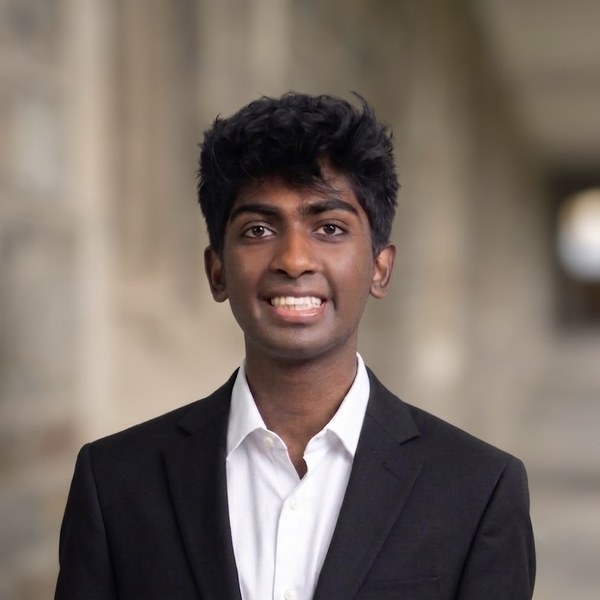
I grew up in Portland, Oregon, and started doing research in high school. I've spent over six years using machine learning for early detection and prevention of cardiovascular disease — starting with simple ECG classifiers, and now focused on synthesizing full 12-lead ECGs for at-home monitoring. My research has taken me to international conferences around the world: first-authored papers at IEEE EMBC and IEEE SENSORS, presentations at the Heart Rhythm Society and AI Med, and two International Science and Engineering Fair (ISEF) Grand Awards.
I currently study computer science at Carnegie Mellon. Along the way I've also captained a FIRST Tech Challenge robotics team for four years and run my small baking business, TnT Treats, since 2019. In 2026 I was named a Coca-Cola Scholar — one of 150 selected from over 110,000 applicants.
Research & projects
I work on developing AI algorithms for the heart, used for early detection, diagnosis, and monitoring of cardiovascular disease. Over the years I've developed a range of algorithms toward those goals.
My current main focus is ECG synthesis. A clinical ECG needs twelve leads and ten electrodes; my work synthesizes a diagnostic-quality 12-lead ECG from a subset of leads that a low-cost wearable can record. That makes at-home monitoring and early detection of cardiovascular disease easier and more accessible. It also lets low-resource regions get high-quality ECGs without the need for expensive ECG recording devices.
Outside this line of research, I've also built IntelliCane, an autonomously navigating cane that actively guides the visually impaired.
-
2025Transformer-Based Framework with Dynamic Multiscale Attention Mechanisms for 12-Lead ECG Synthesis47th IEEE EMBC · First-author full paper · IEEE Xplore & PubMed
I first-authored and presented this paper at the world's largest biomedical engineering conference. I created a custom transformer that uses dynamic scaling windows to capture both the sharp spikes and the subtle waves of a heartbeat, allowing for accurate ECG synthesis. My model can also be fitted to accurately synthesize any type of parallel waveform with minimal work.
-
2025A Morphologically-Aware Transformer Network for High-Fidelity V1–V5 ECG Lead Generation24th IEEE Sensors · First-author full paper · IEEE Xplore
I first-authored and presented this paper at IEEE's flagship sensor conference. Where my EMBC model is general-purpose, this multi-stage transformer is customized to ECGs: the architecture builds in the specific features and complexities of heart waveforms with each stage focused on synthesizing different parts of the ECG (P, QRS, and T segments).
-
2025IntelliCane: A Deep Learning Cane for Active Obstacle Avoidance & Navigation for the Visually ImpairedRegeneron ISEF 2025 · Grand Award, 3rd place · AAAI Special Award
I built the first goal-driven, self-navigating aid for the visually impaired. IntelliCane can interpret destinations in plain language — like “go to a water fountain” — and its camera-based AI agents detect obstacles, find a walkable path, and actively guide the user there with servo steering and spoken directions.
-
2024Validation of Einthoven and Goldberger's Electrocardiographic Lead SystemsHeart Rhythm Society 2024 · Abstract & poster
I re-validated the century-old formulas that modern electrocardiography is built on, comparing their computed leads against real recordings across a range of heart conditions. I presented the work at the Heart Rhythm Society's annual meeting, showing how essential these formulas are for detecting more types of cardiovascular disease from a wearable device with a limited lead set.
-
2024Synthesis of a Diagnostic-Caliber 12-Lead ECG Using a Novel Multi-resolution TransformerRegeneron ISEF 2024 · HRX 2024 · Grand Award, 2nd place
I built my first end-to-end transformer pipeline for generating a diagnostic-quality 12-lead ECG from three recordable leads, pairing the mathematical lead-computation formulas with a multi-resolution neural network personalized to each individual. This is the project that launched my research, and I later presented it at HRX 2024.
-
2023Early Detection and Synthesis of a 12-Lead ECG Using Density-Based Clustering and GANsAI Med 2023 · Youngest of 80+ presenters
I trained a GAN to generate a 12-lead ECG from the three leads a smart device can record, then used clustering against a person's own ECG history to flag early signs of heart disease without the need for pre-labeled data. Because the baseline is the person's own heart, it works even for people with pre-existing conditions, where standard classifiers fall short. I presented this work at AI Med 2023 as the youngest of 80+ pre- and post-doctoral presenters.
Awards
- 2026Coca-Cola Scholar. $20,000 national merit scholarship; 150 recipients from more than 110,000 applicants.
- 2025Regeneron ISEF Grand Award, 3rd place, Robotics and Intelligent Machines, plus the AAAI Special Award.
- 2024Regeneron ISEF Grand Award, 2nd place, Robotics and Intelligent Machines.
- 2023AI-Med Youngest Presenter, among a field of 80+ pre- and post-doctoral researchers.
Skills
Languages
- Python
- Java
- C / C++
- CUDA
- Swift
- JavaScript, HTML
Machine learning
- PyTorch
- TensorFlow / Keras
- Hugging Face
- Scikit-Learn
- XGBoost
Data
- NumPy / SciPy
- Pandas
- h5py
- Matplotlib / Seaborn
Everything else
- React
- Linux
- AWS
- Fusion 360
Contact
I'm always up for collaborations or talking more about my research. Email is the fastest way to reach me.